
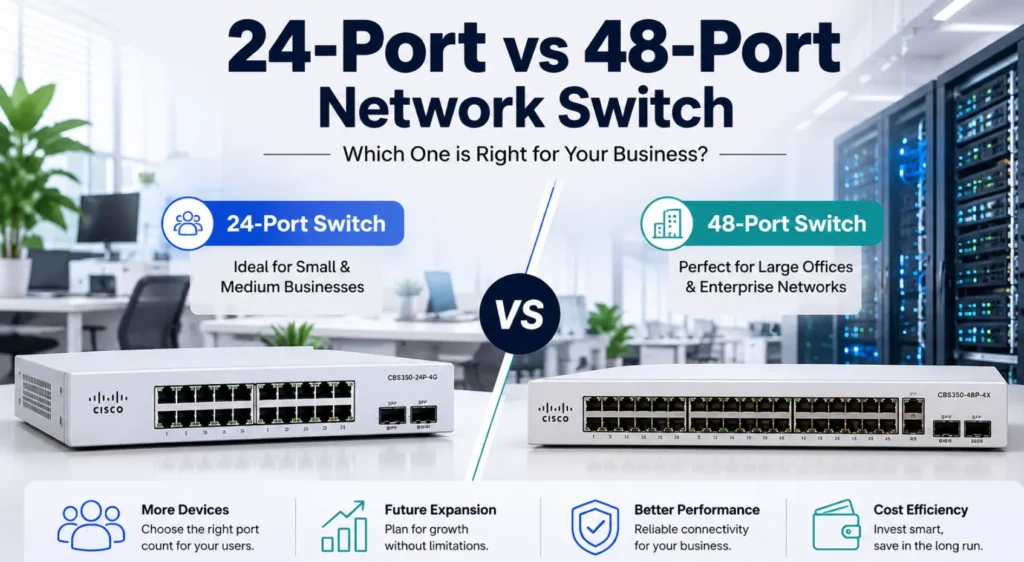
24-Port vs 48-Port
Network Switch
24-Port vs 48-Port Network Switch: Which One is Best for Your Business?
Choosing a network switch isn’t just about buying the one with more ports. The right switch depends on how many devices you have today, how much your business is expected to grow, and what kind of network you’re building.
One of the most common questions businesses ask is whether a 24 port switch is enough or if they should invest in a 48 port switch. Both have their advantages, and the better option depends on your requirements rather than the price alone.
In this guide, we’ll compare 24 port vs 48 port switch options and help you decide which one is the right fit for your business.
What Does a Network Switch Do?
A business network switch connects all the devices on your network so they can communicate with each other.
This includes:
- Desktop computers
- Laptops
- Servers
- Printers
- IP Phones
- CCTV Cameras
- Wireless Access Points
The number in the switch name simply tells you how many Ethernet ports are available.
For example:
- A 24 port switch allows up to 24 wired network connections.
- A 48 port switch supports up to 48 wired devices.
When is a 24-Port Switch the Right Choice?
A 24 port switch is a good option for businesses that don’t have a large number of connected devices.
It works well for:
- Small offices
- Retail stores
- Clinics
- Schools
- Startups
- Small warehouses
If your office currently has around 10–20 network devices, a 24-port switch usually leaves enough room for future additions without paying for unused ports.
Advantages of a 24-Port Switch
- Lower upfront cost
- Uses less rack space
- Lower power consumption
- Easy to manage
- Suitable for most small and medium offices
Many businesses prefer a Cisco 24 port switch because it provides enterprise-grade performance while meeting the needs of growing offices.
When Should You Choose a 48-Port Switch?
A 48 port switch is designed for businesses with larger networks or plans to expand in the near future.
It’s commonly used in:
- Corporate offices
- Manufacturing units
- Hotels
- Hospitals
- Educational campuses
- Data centres
Instead of installing two separate 24-port switches later, many businesses choose a single 48 port switch from the beginning. This makes network management simpler and leaves more room for additional devices.
Advantages of a 48-Port Switch
- Supports more users
- Better for future expansion
- Fewer switches to manage
- Cleaner rack setup
- Easier cable management
If your business is growing quickly, investing in a Cisco 48 port switch can help avoid unnecessary upgrades later.
24-Port vs 48-Port Switch: Quick Comparison
| Feature | 24-Port Switch | 48-Port Switch |
|---|---|---|
| Best For | Small & Medium Businesses | Medium & Large Businesses |
| Number of Devices | Up to 24 | Up to 48 |
| Initial Cost | Lower | Higher |
| Future Expansion | Moderate | Excellent |
| Rack Space | Smaller | Larger |
| Power Consumption | Lower | Higher |
Think About Future Growth
One mistake businesses often make is buying a switch based only on today’s requirements.
For example, if your office currently has 22 connected devices, buying a 24-port switch might seem like the obvious choice. But what happens when you add:
- More employees
- Additional CCTV cameras
- Wireless access points
- IP phones
- New printers
You’ll soon run out of ports and may need to buy another switch.
If you know your business is likely to expand over the next few years, choosing a 48-port switch now can save both time and money.
Do You Need a PoE Switch?
The number of ports isn’t the only thing to consider.
If you’re connecting devices like:
- Wireless access points
- IP phones
- CCTV cameras
a PoE switch can power those devices directly through the network cable.
This removes the need for separate power adapters and makes installation much cleaner.
Related Reading: What is a PoE Switch and Why Businesses Need It?
Managed or Unmanaged?
Both 24-port and 48-port switches are available as managed and unmanaged models.
A managed switch gives you additional features such as:
- VLAN configuration
- Better security
- Traffic prioritisation
- Remote management
- Network monitoring
For most businesses, a managed switch is a better long-term investment.
Related Reading: Managed vs Unmanaged Switches – Which is Better for Business Networks?
Which Cisco Switch Should You Choose?
Cisco offers several switch series suitable for different business sizes.
Some popular options include:
- Cisco CBS350 Series
- Cisco C1300 Series
- Cisco Catalyst Series
These switches are available in both 24-port and 48-port variants, with managed and PoE models to suit different business needs.
If you’re unsure which model fits your network, it’s better to choose based on your number of users, connected devices, and future plans rather than simply selecting the cheapest option.
Buy Genuine Cisco Switches from IT Baba Online
IT Baba Online is a trusted Cisco dealer and supplier in Delhi, serving businesses across India for over 10 years. Located in Nehru Place, one of India’s leading IT markets, we supply genuine Cisco networking products backed by expert guidance and competitive pricing.
Whether you’re looking for a Cisco 24 port switch, Cisco 48 port switch, or other business networking solutions, our team can help you choose the right equipment for your office.
Final Thoughts
When comparing a 24 port vs 48 port switch, there isn’t a single answer that works for every business.
If you have a smaller office with limited expansion plans, a 24-port switch is usually enough.
If your business is growing or you expect to add more devices over the next few years, a 48-port switch can be a smarter long-term investment.
Before making a decision, think about your current network, future growth, and whether you’ll need features like PoE or advanced management. Choosing the right switch today can save you from expensive upgrades later.
Frequently Asked Questions
Yes. For most small offices with fewer than 20 connected devices, a 24-port switch provides enough capacity while leaving a few spare ports for future additions.
A 48-port switch is a good choice if your business is expanding, has many connected devices, or wants to avoid adding another switch later.
Not necessarily. Speed depends on the switch model and specifications, not the number of ports.
For businesses, a managed switch is generally recommended because it offers better security, network control, and flexibility.