
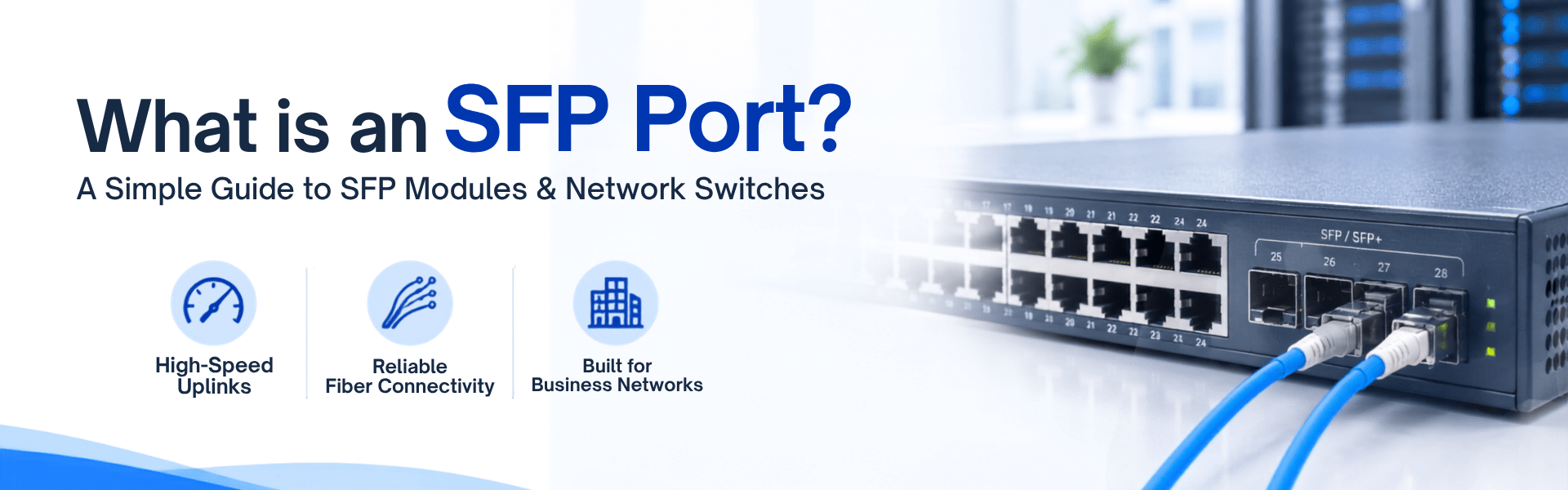
What Is an SFP Port? A Simple Guide to SFP Modules & Network Switches
If you’ve looked at the specifications of a business network switch, you may have noticed terms like SFP port, SFP+, SFP module, or fiber uplink. These terms can be confusing if you’re not familiar with networking hardware.
An SFP port gives a network device more flexibility when it comes to connecting switches, servers, access points, and other networking equipment. Instead of using a regular Ethernet cable directly in the port, you can install an appropriate SFP module and connect the device using copper or fiber, depending on the module.
So, what is an SFP port, and why do so many business and enterprise switches have them?
Let’s break it down.
What Is an SFP Port?
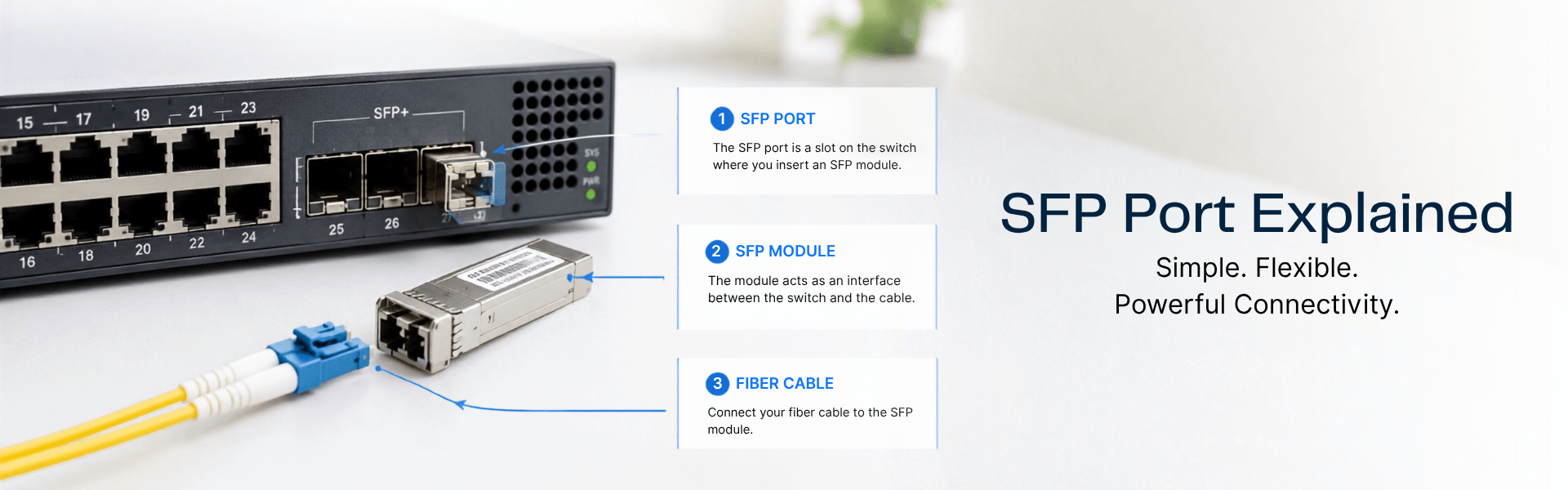
SFP stands for Small Form-factor Pluggable.
An SFP port is a slot on a network device, usually a switch or router, where you can install an SFP module. The module provides the actual connection type required for the network.
For example, an SFP module can allow a switch to connect over:
- Fiber optic cable
- Copper Ethernet cable
- Different fiber types and distances
This makes SFP ports particularly useful when a business needs to connect network equipment over longer distances or use fiber instead of standard copper Ethernet.
You may also see SFP ports referred to as SFP slots or SFP uplink ports.
How Does an SFP Port Work?
An SFP port itself doesn’t usually connect directly to the cable.
Instead, you insert an SFP module into the port.
The basic setup looks like this:
Network Switch → SFP Module → Fiber/Copper Cable → Another Network Device
For example, imagine a business has two switches located on different floors of a building. Instead of running a standard copper Ethernet connection between them, the business could use compatible SFP modules and fiber cable for the connection.
This is commonly referred to as a fiber uplink.
The module can also be replaced if the networking requirement changes, which is one of the main advantages of the SFP design.
What Is an SFP Module?
An SFP module is a small, removable transceiver that fits into an SFP port.
It converts the electrical signals from the networking equipment into the type of signal required for the connection, and vice versa.
Different SFP modules are designed for different applications.
For example, you can find modules designed for:
- Multimode fiber
- Single-mode fiber
- Short-distance connections
- Long-distance connections
- Copper Ethernet connections
When choosing an SFP module, you need to make sure it is compatible with both the networking equipment and the cable being used.
SFP vs RJ45: What’s the Difference?
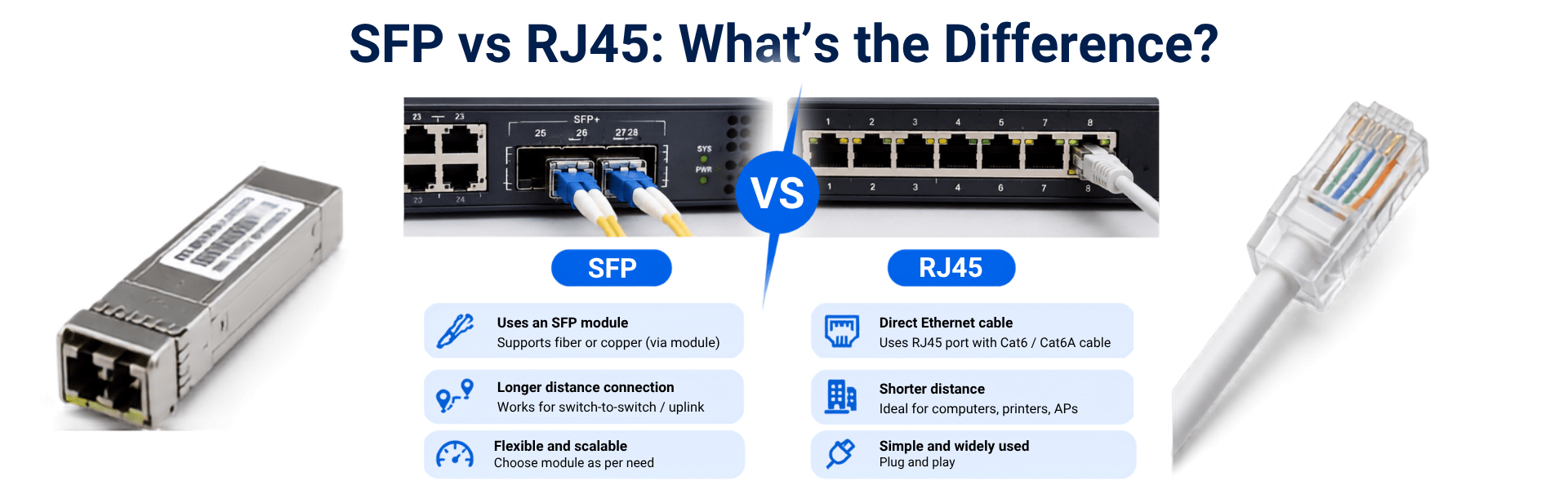
One of the most common questions when choosing networking equipment is SFP vs RJ45.
The main difference is how the connection is made.
| Feature | SFP | RJ45 |
|---|---|---|
| Connection | Uses an SFP module | Direct Ethernet cable |
| Cable | Fiber or copper, depending on module | Copper Ethernet |
| Distance | Can support longer distances | Generally suited to shorter runs |
| Flexibility | High | Simple and straightforward |
| Common Use | Uplinks and switch-to-switch connections | Computers, printers, access points |
RJ45 ports are very common for connecting regular network devices such as computers, printers, IP phones, and access points.
SFP ports are particularly useful for switch-to-switch connections, server connections, and fiber uplinks.
Neither is automatically better. The right option depends on the network design and distance involved.
What Is an SFP+ Port?
You may also come across SFP+ ports when looking at enterprise network switches.
SFP+ is an enhanced version of the SFP interface and is commonly used for 10 Gigabit Ethernet connections.
This makes SFP+ useful when a network needs higher-speed uplinks between:
- Network switches
- Servers
- Storage systems
- Core and distribution switches
For example, a business may use standard Gigabit Ethernet connections for individual users while using an SFP+ uplink between switches to handle the larger amount of traffic moving through the network.
What Is a Gigabit SFP?
A Gigabit SFP is an SFP module designed to support Gigabit Ethernet, generally up to 1 Gbps.
These modules are widely used in business networks for connecting switches and other networking equipment.
The exact distance and type of connection depend on the particular module.
For example, different Gigabit SFP modules may be designed for:
- Multimode fiber
- Single-mode fiber
- Copper connections
This is why it’s important to check the specifications before purchasing an SFP module.
Why Do Network Switches Have SFP Ports?
SFP ports give switches additional connectivity options.
A typical business switch might have:
24 × RJ45 ports + 4 × SFP uplink ports
The RJ45 ports can be used to connect computers, printers, access points, IP phones, and other devices.
The SFP ports can then be used to connect the switch to another switch, server, or the wider network.
This setup is especially useful in larger offices where network traffic needs to move between different floors, buildings, or parts of the network.
When Should You Use an SFP Port?
SFP ports are particularly useful in situations where standard copper Ethernet isn’t the best option.
Connecting Different Floors
Fiber can be used to connect switches located on different floors of an office building.
Connecting Different Buildings
If network equipment needs to be connected across buildings, fiber uplinks can provide a practical solution for longer distances.
High-Speed Uplinks
SFP+ can provide higher-speed connections between switches and servers.
Network Expansion
SFP ports make it easier to add additional switches to an existing network without relying entirely on copper connections.
SFP vs SFP+: Which One Should You Choose?
The choice depends mainly on the speed your network requires.
SFP is commonly used for Gigabit connections.
SFP+ is commonly used for 10 Gigabit connections.
If you’re building a standard office network, Gigabit SFP may be enough. If you’re connecting high-traffic servers or building a larger enterprise network, SFP+ may be a better choice.
It’s also important to check whether both devices support the same interface and speed before purchasing the modules.
Are SFP Ports Only Used for Fiber?
No.
Although SFP ports are commonly associated with fiber optic connections, you can also use certain copper SFP modules.
These modules allow an SFP slot to support a copper Ethernet connection.
This gives businesses more flexibility when designing or upgrading their network.
However, compatibility is important. You should always check the switch manufacturer’s specifications before selecting an SFP transceiver.
What Should You Check Before Buying an SFP Module?
Buying an SFP module isn’t simply about choosing the cheapest one that fits the port.
Check these specifications first:
1. Speed
Make sure the module supports the required speed, such as 1 Gbps or 10 Gbps.
2. Fiber Type
Check whether you need single-mode or multimode fiber.
3. Distance
Different modules are designed for different transmission distances.
4. Connector Type
Make sure the module matches the connector used by your fiber cable.
5. Device Compatibility
The module should be compatible with your network switch, router, or other networking equipment.
For branded equipment, such as Cisco switches, it’s particularly important to check the supported transceiver specifications.
Cisco SFP Modules and Business Networking
Cisco networking equipment commonly includes SFP and SFP+ interfaces across different switch and networking product ranges.
A Cisco SFP module can be used to provide the appropriate connectivity for supported Cisco networking equipment.
If you’re already using Cisco switches, make sure the SFP module you select is supported by your particular switch model and matches the required speed, fiber type, and distance.
This is especially important in enterprise deployments where compatibility and reliability matter.
SFP Ports in Business and Enterprise Networks
SFP ports are not limited to large data centers.
They can be useful in many environments, including:
- Corporate offices
- Schools and colleges
- Hospitals
- Hotels
- Warehouses
- Manufacturing facilities
- Data centers
- Multi-floor buildings
For a small office, SFP ports may simply be used for an uplink to another switch.
In a larger enterprise network, they can form an important part of the connection between access, distribution, and core network equipment.
Do You Need an SFP Switch?
If you’re purchasing a network switch, having SFP ports can be useful even if you don’t need them immediately.
An SFP switch gives you the option to use fiber or compatible modules later as your network grows.
For example, you might initially connect your office devices through RJ45 ports. As the business expands, you can use the SFP uplinks to connect additional switches or extend the network.
That extra flexibility can be useful when planning a network for future growth.
Common Mistakes When Choosing SFP Modules
A few mistakes can cause problems during installation.
Choosing the Wrong Speed
A module designed for a different speed may not work as expected with your equipment.
Ignoring Fiber Type
Single-mode and multimode fiber are not interchangeable for every application.
Not Checking Distance
A module designed for short-distance transmission may not be suitable for a long fiber run.
Assuming Every Module Works With Every Switch
SFP compatibility can depend on the manufacturer and specific device model.
It’s always better to check the switch specifications before ordering.
Buy Network Switches and SFP Solutions from IT Baba Online
IT Baba Online is a networking products distributor and supplier in Delhi, serving businesses across India for more than 10 years. Based in Nehru Place, Delhi’s well-known IT and electronics market, we supply networking equipment for businesses, system integrators, and IT requirements.
Our networking range includes Cisco switches, Ruijie switches, SFP modules, fiber networking products, PoE switches, wireless access points, and other enterprise networking solutions.
If you’re unsure about which SFP module, switch, or fiber connectivity solution you need, our team can help you select products based on your equipment, speed requirements, and network setup.
Final Thoughts
An SFP port may look like a small part of a network switch, but it can make a big difference when you’re planning how different parts of a network will connect.
For a basic office setup, RJ45 Ethernet ports may be all you need. But when you need longer connections, fiber, higher-speed uplinks, or more flexibility, SFP and SFP+ ports become much more useful.
Before buying an SFP module or an SFP switch, check the required speed, cable type, transmission distance, connector, and device compatibility.
Getting these details right from the beginning can save you from compatibility problems and unnecessary replacements later.
Frequently Asked Questions
An SFP port is used to connect compatible SFP modules for network connections, including fiber and certain copper Ethernet connections. They are commonly used for switch uplinks and connections between networking devices.
Not necessarily. SFP is more flexible for fiber and longer-distance connections, while RJ45 is simple and widely used for standard Ethernet connections. The right choice depends on the network requirement.
SFP is commonly used for Gigabit Ethernet, while SFP+ is commonly used for 10 Gigabit Ethernet. The exact capabilities depend on the equipment and module.
Yes. With a compatible fiber SFP module installed, an SFP port can be used for a fiber optic connection.
No. Compatibility depends on the switch, module specifications, speed, fiber type, and sometimes the manufacturer’s supported transceiver list. Always check compatibility before purchasing.